
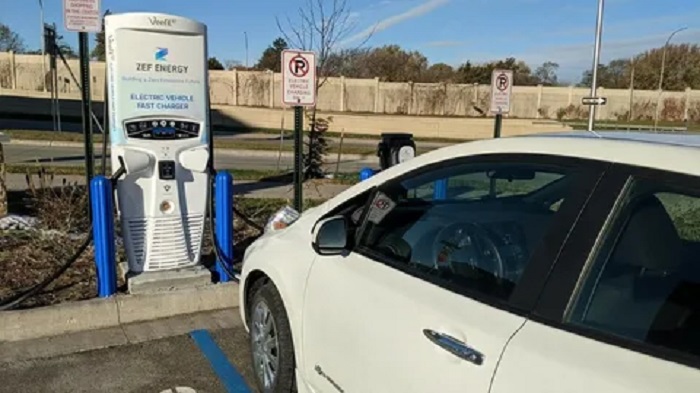
DC fast charging has a grid problem. The driver wants a short stop. The utility sees a large, sudden load. For a rural corridor site, hotel, fleet depot, or retail parking lot, that mismatch can turn a good charging idea into a long and expensive infrastructure project.
Battery-buffered DC fast charging uses an energy storage system as a middle layer. The battery charges from the grid or solar at a steadier rate, then discharges at higher power when a vehicle plugs in. The driver gets fast charging, while the grid connection sees a smoother load.


Why the Grid Upgrade Question Matters
Traditional DC fast charging can require major service upgrades, new transformers, and long utility timelines. That is not always practical for sites with limited local capacity or uncertain early charging demand.
The U.S. Department of Energy’s AFDC reports that appropriately sized battery-buffered systems can reduce required grid service capacity by about 50 percent to 80 percent compared with a station powered entirely by the grid, while providing a similar driver experience. That is the core value of the buffer: it separates the charger’s peak output from the site’s grid draw.
This does not eliminate planning. It changes the planning problem. Instead of asking only how large the utility service must be, the site owner also asks how much battery capacity is needed, how quickly it can recharge, and how many charging sessions the site must support on a busy day.
A Simple Way to Picture It
Think of the ESS like a water tank. The grid connection is the pipe filling the tank. The charger is the hose draining it quickly when a vehicle arrives. A smaller pipe can still support a high-flow hose if the tank is sized properly and has enough time to refill between sessions.
That analogy is not perfect, but it explains why utilization matters. A lightly used corridor charger may work well with a moderate grid connection and battery buffer. A busy urban site with back-to-back fast charging sessions may need larger storage, higher grid capacity, or both.
ESYsunhome lists ES125-261 ESS as a 125 kW, 261 kWh C&I energy storage product. Product categories like this are relevant to battery-buffered charging because the storage system has to deliver meaningful power, not just small backup capacity. Site owners can review the broader product range at https://www.esysunhome.com/products/.
What ESS Can and Cannot Fix
ESS can reduce peak demand, improve resilience, and make solar integration more useful. It can also help avoid paying for oversized infrastructure before charging demand is proven. For businesses, that can mean a more gradual path into EV charging.
But the battery is not magic. If it is undersized, the station may slow down after several sessions. If software controls are weak, demand charges can still appear. If thermal management and safety design are poor, reliability suffers. The AFDC also notes that adding storage increases capital cost and introduces another equipment system to maintain.
Good Sites for Battery-Buffered Charging
The strongest candidates are sites with limited grid capacity, variable charging demand, high demand charges, solar generation, or resilience needs. Hotels, factories, apartment communities, retail centers, and highway stops can all fall into this category.
Battery-buffered fast charging is not only about speed. It is about making charging deployable in places where a pure grid-powered design would be too slow, too expensive, or too rigid. The right ESS turns fast charging from a grid shock into a managed energy load.